
Body Composition Basics # 3
Teaser & Intro
In order to determine the progress of your physique development based on your body composition, you need a good tracking system. This system should be as easy to implement as possible and provide accurate values for your fat and muscle mass – or at least good indications of their relative changes.
After the basics of measuring body composition in the first part, this post is about what you need for this tracking system, how to set it up, use it continuously and work with the measured values. This will allow you to effectively evaluate the effectiveness of your diet or hypertrophy program and adjust it in a targeted manner to optimize your results.
Recap: Body Composition Measurement Methods
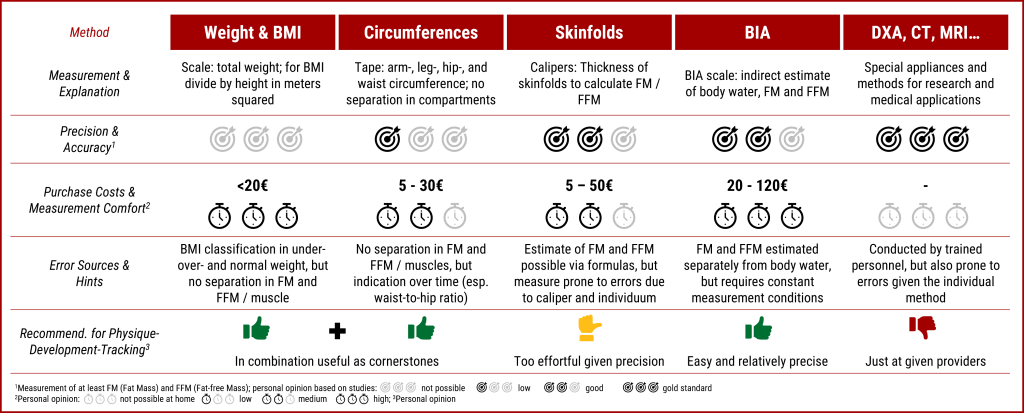
In the graphic you will find an overview of the most relevant information on the most common body composition measurement methods. You can find the details of the individual methods in the first post on body composition measurements.
Summary of the Advantages and Disadvantages of the Individual Measurement Methods
Below we will introduce you to the tracking system that we also use in our coaching. This allows us to reliably assess the condition and development of body composition for our clients – and you can too – with a focus on physique development and to make targeted adjustments to the diet or training during a fat loss or hypertrophy phase.
The tracking system includes several measurement and evaluation methods that offer a good compromise between accuracy, cost and effort: On the one hand, the methods marked with a green “thumbs-up” from the table (weight & BMI + circumference measurements and BIA), and on the other hand, two other “methods” that are not listed in the table. The latter are either very subjective or, as a control value in combination with the other measured values, allow conclusions to be drawn about your body composition: Pictures and performance measurements for specific exercises in your resistance training workouts.
Tracking System for Physique Development
In the following sections, we will explain the tracking system along the individual measurement and evaluation methods. We will address the following points for each method:
- How, when and how often you should take the measurement and what you should pay attention to.
- What the measured values and their changes mean for your body composition and physique development – specifically for fat loss and muscle building.
- Which criteria you should use to make adjustments to your programs.
But note the following: Especially in the first few days of a phase – regardless of whether it is for fat loss or muscle building – the measured values or their changes from most measuring methods are not very meaningful with regard to the relevant body components of (storage) fat and muscle mass. This is because body water can fluctuate greatly and can therefore distort some measured values - especially body weight and circumference values, but also others – up or down [1] [2] [3]. This means that the measured values should be treated with caution in the first few days and should not be over-interpreted. From about the second week onwards, the changes in the measured values can be more reliably attributed to changes in body fat or muscle mass and are therefore more meaningful.
The Cornerstones: Anthropometric Measurements
Body Weight & BMI
As a basis, you should weigh yourself every day. It is important that you ensure consistent measurement conditions in order to keep fluctuations caused by body water and food consumed during the day as low as possible. It is best to weigh yourself first thing in the morning after getting up and a quick trip to the toilet. Any normal scale will do for your total body weight, but you can kill two birds with one stone by determining your weight with a BIA scale (more on this below). You can also easily determine your BMI using your body weight. Most tracking programs calculate this value automatically. You can also calculate your BMI yourself (e.g. online or in Excel) very easily (weight in kg divided by height in m squared, e.g. 75 kg / 1.80 m2 = 23.15).
As mentioned, your starting values in the first measurements are not very meaningful. At most, they give you initial information about whether you should start with a fat loss or muscle building phase for effective physique development (more on this in a separate post).
The value change and its evaluation, however, is quite obvious: If you want to lose fat, your overall weight should also decrease, and if you want to build muscle, your overall weight should increase (the special case of body recomposition, in which you lose fat and build muscle while maintaining a stable body weight, is also the subject of a separate post). Important: It is best to take the average of a whole week and compare these average values with each other, as even after the first few days or weeks, strong daily weight fluctuations can occur. These weight fluctuations then usually have little to do with fat or muscle mass, but rather with water retention due to stress or other factors [1] [4].
If you want to lose fat, your average body weight – and with it your BMI – should decrease from week to week. If this is not the case for at least two consecutive weeks, you should make some adjustments to your diet or training to ensure a (larger) calorie deficit (see the posts on fat loss). The reverse of this also applies to muscle building: If you do not gain weight for at least two consecutive weeks, you usually need a (larger) calorie surplus or adjustments to your training (see the posts on hypertrophy).
At this point, a note on BMI: The fact that BMI (as also explained in connection with weight) is not very meaningful for assessing body composition and its changes applies above all to high BMI values: For example, according to the BMI reference values, many bodybuilders would be overweight (BMI > 25) or even obese (BMI > 30) [5], even though they usually have low body fat percentages but a lot of muscle mass [3]. However, this cannot be easily transferred to low BMI values: Underweight (BMI < 18.5) offers less room for interpretation – there is (too) little body mass overall for the respective body size, regardless of body composition. Therefore, a (very) low BMI should at least make you pay attention in order to avoid possible health complications [6].
Since your weight measurements alone are not very meaningful for your physique development, you should supplement them with other measurement methods. First and foremost, these are circumference measurements.
… in Conjunction with Circumference Measurements
When measuring circumferences, you are obviously measuring the circumference of different parts of the body. Here, too, you should ensure that the measuring conditions are consistent, otherwise the measurement results are not very meaningful and cannot be compared over time:
- It is best to measure the circumferences together with your weight, i.e. in the morning after getting up.
- Make sure that you always measure the respective circumferences in exactly the same place – e.g. the waist circumference at the level of the belly button.
- Make sure that the measuring tape is evenly tensioned when measuring: The measuring tape should lie directly on the skin all around the relevant part of the body “without pulling”, i.e. so that the measuring tape does not tighten the part of the body.
It is sufficient to carry out the circumference measurements once a week. You should measure to the millimeter in order to potentially detect small changes.
You can measure circumferences with any tape measure that you can buy for a few cents in any hardware store. However, special body measuring tapes are actually practical. These measuring tapes have a body into which you can hook the ends of the measuring tape, making it easier to pull the tape together to the same tension, and then easily measure circumferences with one hand. You can get body measuring tapes for under €10 – we have linked an example here as well as listed in our overview of product recommendations. Even more convenient are body measuring tapes that send the measured values directly to your smartphone via Bluetooth, so that you can easily collect the values over time.
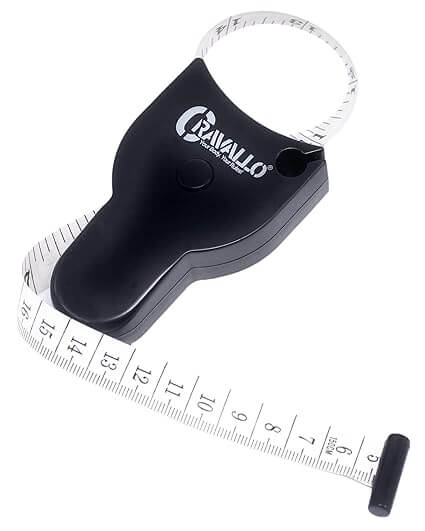
When measuring circumferences, you should definitely measure the waist (at the level of the belly button) and the hips (at the thickest part of the booty). We also recommend that our clients measure their waist three finger widths above and below the belly button, as well as their upper arm and thigh circumference. You can of course measure any other useful part of the body that is of interest, e.g. the calf or the chest.
Even if circumference measurements do not directly say anything about the body composition at the respective body parts, they are still useful for assessing physique development. The reason for this and for the measurements at the different places – especially the waist and hips – is that the fat mass is not evenly distributed across the body and is broken down unevenly [7]. This fact makes the waist-to-hip ratio (WHR: waist circumference divided by hip circumference) a fundamentally indicative value that only consists of circumference measurements: the smaller this value (becomes), the lower your body fat percentage (%BF) usually is or becomes.
If circumferences are considered in conjunction with body weight, the value changes allow for even clearer conclusions to be drawn about physique development, especially in relation to (preferably) fat-free muscle building. If your waist circumference remains almost the same when you gain weight, you are very likely to build muscle with manageable changes in fat mass, as the waist circumference is mainly influenced by the fat stored there, but the abdominal muscles show comparatively little change in volume. You can assess increases in muscle mass primarily based on increasing upper arm, thigh and chest circumferences.
The Scoreboard: BIA Measures
In order to obtain concrete and as accurate as possible values for fat and muscle mass, you need more advanced measurement methods. Depending on the technology, BIA scales allow a relatively accurate determination of body composition separated into at least three compartments [8]. In the BIA measurement, the amount of body water is determined in isolation and the fat and fat-free mass is derived from this. Changes in body weight can therefore be specifically attributed to changes in cell mass (fat or muscle) or (!) body water and therefore do not lead to incorrect conclusions [9].
Nevertheless, BIA measurements are also susceptible to errors, especially due to the hydration status and food intake before a measurement, i.e. when and how much you drank and ate before a measurement [10]. Therefore, as with the other measurements, you should make sure to take the measurement ideally in the morning immediately after getting up and a detour to the toilet. Here, too, you should look at the measured values for weight and the various body components – especially fat and muscle mass – on average over a week. Apart from that, BIA scales are very easy to use and deliver the measured values or estimates for %BF, muscle mass, body water and weight within seconds – usually via Bluetooth to your smartphone.
As mentioned in the previous post, the manufacturer and the applied technology of the BIA scale plays a role in the accuracy of determining the values of the body composition, i.e., the compartments [11]. BIA scales for home use can be bought for well under €100 – sometimes even for just €20. We have linked a BIA scale that performs very well according to test values here as well as in our list of product recommendations: In a test carried out with the Technical University of Munich, in which the measurement accuracy of various BIA scales for private use was checked using reference values from an MRI-validated, medical whole-body scale, this one showed the lowest average measurement error of body fat percentage (2.3%) [12].
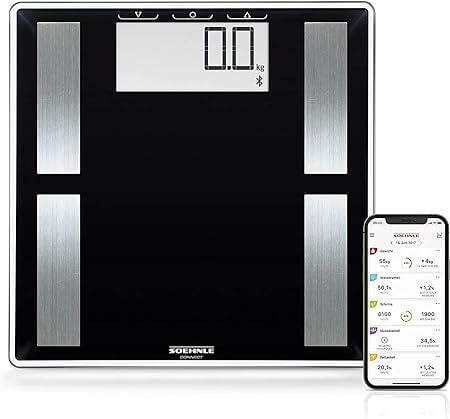
Handling the measured values of the BIA scales is extremely simple. For fat loss, you ideally want to see that your body weight loss is largely due to a decrease in fat mass while keeping muscle mass as constant as possible. When building muscle, you want to see a weight gain through increasing muscle mass values while keeping fat mass as constant as possible. In both cases, the body parts that you want to keep constant will always lose or gain at least slightly. But if this remains within a manageable range, you are on the right track. If not, you may need to adjust your calorie balance to avoid losing unnecessary amounts of muscle mass during a diet or putting on unnecessary amounts of fat during a muscle building phase.
The Add-On: Images & Performance Measurements
You are almost certainly not just looking to lose fat or build muscle for the sake of the measurements themselves, but you also bring a healthy (or even more) vanity and athletic ambition to your fat loss or muscle building efforts – that is essentially what physique development is all about, beyond the health aspects of course. Therefore, pictures and performance measurements are not only allowed, but even encouraged.
Pictures
In most cases, it is sufficient to take pictures of yourself once a month – in some situations more often. If you take pictures and are not already an Instagram aficionado/afficionada, consider the following:
- Take pictures of yourself in the same pose from the front, from the side, and possibly with your back to the camera – of course you should wear as little clothing as possible so that you can see as much of your body as possible directly. Ideally, you should use a tripod.
- Be consistent, i.e. take pictures in the same lighting and with the camera conditions and body tension.
The advantage of pictures over a quick look in the mirror is that pictures allow a more neutral view and are not influenced by the moods of the moment. The basic assessment here is pretty obvious if you do not have a body perception disorder (if you do, please seek professional help): Do you like what you see in your most recent pictures and do you like them better than the previous ones? Then you are on the right track. As an upfront note: As a general guideline, it can be helpful to make sure that you can at least recognize your ab muscles throughout a muscle building phase in order to be able to counteract too high of a %BF at an early stage for a variety of reasons.
Performance Measures
Especially if you want to build muscle, but also when you are dieting, certain performance measurements are almost essential as an additional source of information. On the one hand, you should always keep an eye on your performance in your regular workouts in order to be able to ensure your progress. However, you can also measure your performance in certain resistance training exercises that you ideally do not otherwise do (regularly) in your workouts. Then you compare the values at the different measurement times. You should record your maximum performance in a repetition range of around 10 – 20.
Example: In your workouts, you train your legs almost exclusively with a selection of the following exercises: squats, deadlifts, leg press, leg curls, and calf raises. Since you do not train your legs with a leg extension, this exercise is suitable for this sort of performance measurement as a basis for evaluating physique development. To do this, you then take a weight after one or two warm-up sets that you assume you can do at least 10 but no more than 20 repetitions with. You then do a set until muscle failure – that is, as many repetitions as you can no longer stretch your legs with consistently perfect technique. You compare the number of repetitions with the number you can do several weeks later with the same exercise with the same weight.
The reason for the usefulness of this method is that performance improvements – i.e. more repetitions of this exercise with the same weight – are not due to neuromuscular adaptations in this repetition range and are not due to practice effects [13] [14], but primarily to general increases in (leg) muscle mass. In combination with body weight increases on the scale, if your performance increases with this method, you can be fairly certain that you have built muscle.
Take-Aways
In the graphic you can see the tracking system for physique development summarized. The overview shows you how you should use the measurement methods and which guidelines will help you evaluate the measured values and whether you are getting closer to your physique goals.
Summary of the Tracking System
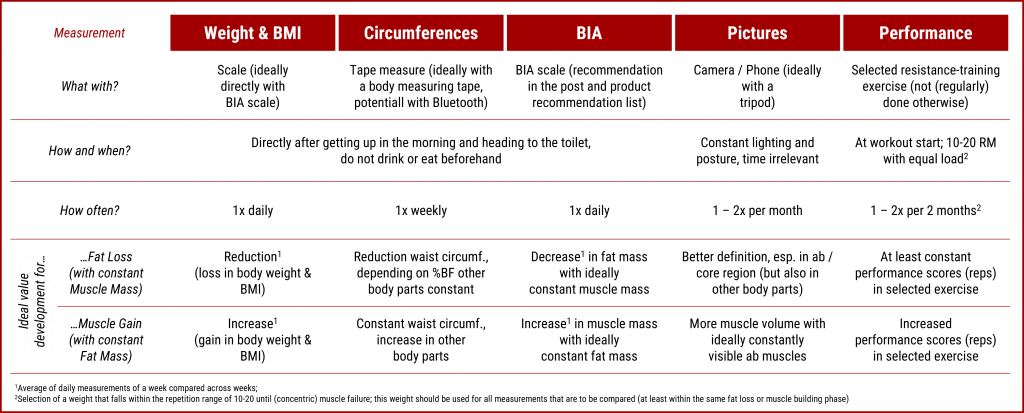
As mentioned, we also use this tracking system in our coaching to evaluate the physique development of our clients. Carrying out all the measurement methods at the suggested times should not take you more than 5 minutes per day. For this effort, you get a measurement system that tells you very accurately at any time during your physique development whether you need to adjust something in your fat loss or muscle building strategy or whether you are getting closer to your goals in the long term.
Outlook
This tracking system includes the measurement methods that allow you to evaluate your physique development results – i.e. the outcomes. Tracking the parameters on the input side is at least as important.
In future post series we will introduce you to the additions to the tracking system presented here. These include tracking your diet, your resistance training or cardio workouts (performance values and progress as well as recovery), and other factors (e.g. sleep).
In the next posts on body composition basics, there will be more on muscle and fat tissue, how the different types of body composition tissues influence our performance and health, why it is important to achieve or maintain a “healthy” body composition, and what comparison values and standard ranges exist for a “healthy” body composition.
References
[1] L. B. Baker, J. A. Lang, and W. Larry Kenney, “Change in body mass accurately and reliably predicts change in body water after endurance exercise,” Eur. J. Appl. Physiol., vol. 105, no. 6, pp. 959–967, Apr. 2009, doi: 10.1007/s00421-009-0982-0.
[2] T. Abe, S. J. Dankel, and J. P. Loenneke, “Body Fat Loss Automatically Reduces Lean Mass by Changing the Fat‐Free Component of Adipose Tissue,” Obesity, vol. 27, no. 3, pp. 357–358, Mar. 2019, doi: 10.1002/oby.22393.
[3] W. D. Van Marken Lichtenbelt, F. Hartgens, N. B. J. Vollaard, S. Ebbing, and H. Kuipers, “Body Composition Changes in Bodybuilders: A Method Comparison,” Med. Sci. Sports Exerc., vol. 36, no. 3, pp. 490–497, Mar. 2004, doi: 10.1249/01.MSS.0000117159.70295.73.
[4] E. A. Cumberledge, C. Myers, J. J. Venditti, and J. L. Andreacci, “The Effect of the Menstrual Cycle on Body Composition Determined by Contact-Electrode Bioelectrical Impedance Analyzers,” 2018.
[5] R. C. Weisell, “Body mass index as an indicator of obesity,” Asia Pac. J. Clin. Nutr., vol. 11, no. s8, Dec. 2002, doi: 10.1046/j.1440-6047.11.s8.5.x.
[6] K. Maeda, Y. Ishida, T. Nonogaki, and N. Mori, “Reference body mass index values and the prevalence of malnutrition according to the Global Leadership Initiative on Malnutrition criteria,” Clin. Nutr., vol. 39, no. 1, pp. 180–184, Jan. 2020, doi: 10.1016/j.clnu.2019.01.011.
[7] E. L. Thomas, J. A. Fitzpatrick, S. J. Malik, S. D. Taylor-Robinson, and J. D. Bell, “Whole body fat: Content and distribution,” Prog. Nucl. Magn. Reson. Spectrosc., vol. 73, pp. 56–80, Aug. 2013, doi: 10.1016/j.pnmrs.2013.04.001.
[8] L. C. Ward, “Bioelectrical impedance analysis for body composition assessment: reflections on accuracy, clinical utility, and standardisation,” Eur. J. Clin. Nutr., vol. 73, no. 2, Art. no. 2, Feb. 2019, doi: 10.1038/s41430-018-0335-3.
[9] U. G. Kyle et al., “Bioelectrical impedance analysis—part I: review of principles and methods,” Clin. Nutr., vol. 23, no. 5, pp. 1226–1243, Oct. 2004, doi: 10.1016/j.clnu.2004.06.004.
[10] G. M. Tinsley, E. Morales, J. S. Forsse, and P. W. Grandjean, “Impact of Acute Dietary Manipulations on DXA and BIA Body Composition Estimates,” Med. Sci. Sports Exerc., vol. 49, no. 4, pp. 823–832, Apr. 2017, doi: 10.1249/MSS.0000000000001148.
[11] M. I. Frisard, F. L. Greenway, and J. P. DeLany, “Comparison of Methods to Assess Body Composition Changes during a Period of Weight Loss,” Obes. Res., vol. 13, no. 5, pp. 845–854, May 2005, doi: 10.1038/oby.2005.97.
[12] L. Kathrin, “Körperfettwaagen-Test: So präzise sind Körperanalysewaagen,” Fit For Fun. Accessed: Mar. 07, 2024. [Online]. Available: https://www.fitforfun.de/artikel/koerperfettwaagen-test-so-praezise-sind-koerperanalysewaagen_238996
[13] L. L. Ploutz, P. A. Tesch, R. L. Biro, and G. A. Dudley, “Effect of resistance training on muscle use during exercise,” J. Appl. Physiol., vol. 76, no. 4, pp. 1675–1681, Apr. 1994, doi: 10.1152/jappl.1994.76.4.1675.
[14] D. G. Sale, “Neural adaptation to resistance training,” Med. Sci. Sports Exerc., vol. 20, no. 5, p. S135, Oct. 1988.