Body Composition Basics # 2
Teaser & Intro
Let’s say you want to lose weight for the summer and decide to diet and exercise for a while. As already explained in the post on the basics of body composition, it’s not primarily about just losing weight. The part of your body weight that you want to lose when you diet is body fat, while you want to keep other components such as muscle mass constant. If you then want to build muscle (hypertrophy) after the summer, ideally this should also happen with only minimal fat gain at the same time. The question that now arises: How can you determine and evaluate whether your diet or hypertrophy program is having the desired effect and whether your weight loss is mainly due to fat loss, or whether during your hypertrophy program you are keeping your body fat percentage (BFP or Body Fat Percentage; %BF) as low as possible while building muscle?
This and the next post in the Body Composition Basics series are about measuring body composition. In the first part, you will learn everything about the basics of body composition measurement: what constitutes “good” body composition measurements, which measurement methods you can use at home and what you should generally consider if you want to use them to evaluate your progress in physique development.
The second part is about the specific application: There we will introduce you to a low-effort but quite accurate tracking system with which you can whether your diet and muscle building program are achieving the desired results or whether you need to adjust something. If you want to go straight to the applications, you can of course skip this article. We still recommend this article on the basics of body composition measurement so that you understand the background of the tracking system. This article also contains Read-for-Geeks sections. Here we go into the scientific background in detail. If you read this article and still think that this is too much information, you can simply skip these sections.
Measuring Body Composition
When measuring body composition, it is important to determine the current state of the body in terms of its total mass, but above all in terms of the mass of its components (compartments). The most interesting components in the context of physique development are obviously body fat (fat mass; FM) and muscles (as part of the protein tissue of the fat-free mass; FFM). On the other hand, in addition to the current state, the change in state is particularly interesting, i.e. how the body components change in their relationship over time.
That’s why “good” Measurements are important
As already mentioned at the beginning, you can only evaluate whether, for example, your diet is producing the desired results if you have the right information. To get this information, you have to measure your body composition. This not only allows you to evaluate your starting point and your progress, but also whether and in what way you need to adjust if something doesn’t go according to plan – you can react and become able to act.
Measurements also provide another important advantage: “What gets measured gets managed”. Correct and regular measurements not only provide you with a basis for making decisions, but also draw your attention to them – you focus on the essentials at the right time.
So much for the why. However, you shouldn’t just measure for the sake of it, but rather (only) carry out the measurements that also provide you with the right information.
What determines good Measurements with regard to Physique Development
The question of good measurements (or measurement methods) for physique development can be answered using two criteria. Firstly, there is the measurement quality as a general criterion. Secondly, one aspect of the measurement quality can also be used to derive the specific criterion of interest: Whether we are correctly measuring what we want – in the context of physique development, the body composition separated into the compartments, especially fat and muscle mass – or at least getting sufficient indications of their changes.
Read-For-Geeks: Measurement Quality
The measurement quality of any measurement instrument can be assessed using three scientific quality criteria: objectivity, reliability (often also called precision) and validity (often also called accuracy). Validity requires reliability, and reliability in turn requires objectivity.
Objectivity indicates that a measurement, its result and the interpretation of the result are independent of the person who carries it out. For measurements that leave a lot of room for subjective leeway or require trained personnel, objectivity is often a problem – but not if the implementation and evaluation are not very complex. Measuring body weight with a scale is generally very objective: You can hardly go wrong when standing on it and reading the number displayed.
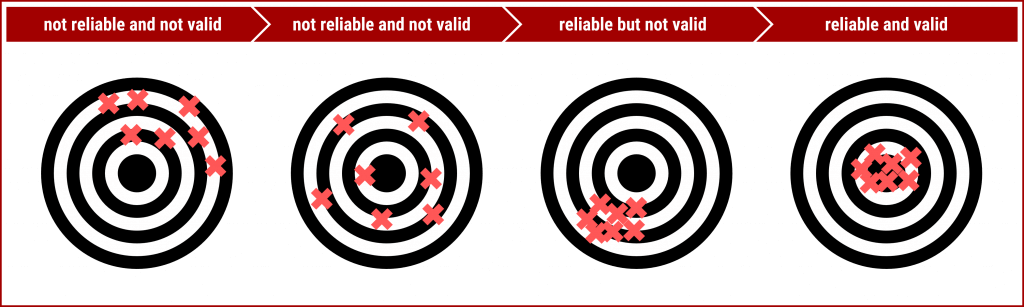
Reliability indicates the trustworthiness of a measurement, i.e. whether a measurement method measures as it is supposed to and whether the measurement is not influenced by variance or unsystematic distortions. Reliable measurements produce the same results when they are carried out several times under the same conditions. Here too, measuring body weight with a scale is an example of a (typically) reliable measurement: If you step on the scale 10 times in a row, you will see the same weight 10 times – if not, there is something wrong with your scale.
Validity indicates whether a measurement method measures exactly what you want to measure, i.e. how “applicability” a measurement is. Depending on the measurement method, there are many different ways to determine validity. In the simple case of body weight measurement, however, this is easy to illustrate: If you want to measure your body weight, you use a scale, not a tape measure. The scale is designed to determine mass or weight, a tape measures distance.
The graphic once again illustrates the concepts of reliability and validity. One could say that with low reliability, a measurement can still be valid if the measured values all scatter around the value that actually exists in reality (see second image from the left). Since we can only get the true value from a single measurement with a lot of luck, a valid measurement generally requires reliability.
Relationship between Reliability and Validity
Measurements separated by Compartments
With regard to physique development, you are primarily interested not in your body weight as a whole, but in your body fat and muscle mass. To get this information, you need measurement methods that measure your body composition separately according to these compartments (or at least allow sufficiently good conclusions).
Overall, this is easier for body fat than for muscle mass, since fat mass (FM) already represents its own compartment in the 2C model. Some measurement methods that are easy to carry out at home already provide good information for this – at least for its change over time. With regard to measuring muscle mass, however, you would need measurement methods that can separate the body composition into the compartments according to a 3C or better 4C model. But there are also good solutions for this at home. If you want to find out more about the composition of the body according to the various compartment models, take a look at the first post of Body Composition Basics.
Measurement Methods
Below we present the different methods for measuring body composition that you can carry out yourself. The methods can be classified according to whether they determine your body composition overall and derive it indirectly or whether they record it specifically for different parts of the body [1]. For each of the methods, you will learn the background and how it works, how accurate and useful the method is for measuring and tracking fat and muscle mass over time, and what other advantages and disadvantages the method has.
Basic Anthropometric Measurements: Scale & Tape Measure
Anthropometric (literally: measuring humans) methods of measuring body composition include, in their simplest form, a scale and a tape measure. Scales usually measure your body weight very reliably – but only as a whole.
Since a scale alone does not tell you anything about your body composition separated into fat and muscle, it is not at all suitable for assessing physique development at a moment’s notice and only partially suitable for tracking over time. When you stand on a scale, you do not know how many kilos on the display are fat, muscle and other parts of the body. The situation is not much different when it comes to assessing whether your diet is effective for fat loss or your hypertrophy program is effective for muscle building. Although you know with some certainty that you have not lost fat if you weigh 5 kg more after a month of dieting, but it is not the same the other way round. Weight loss can have various causes: Larger fluctuations in weight, especially in the short term, are caused by changes in body water and short-term weight loss does not necessarily have to be accompanied by fat loss [2] [3] [4]. However, a scale will not tell you anything about that.
On the positive side, the scale offers an easy-to-use, inexpensive, reliable and valid measurement at least for body weight as a whole. In addition, weight is useful in conjunction with other anthropometric measurements – especially as a control value.
The simplest additional measurement you can include is height. If you square this (in meters) and divide your body weight by this value, you get the Body Mass Index (BMI). This puts your body weight in relation to your height – as the formula for the calculation shows. Using your BMI, you can use reference tables to determine whether you are generally underweight (BMI < 18.5), of normal weight or overweight (BMI > 25) for your height [5]. The advantage is that your BMI only changes depending on your body weight once you are fully grown. The disadvantages are, however, the same as those that generally apply to body weight as a measure of body composition and its changes.
It gets more interesting if you use a tape measure to measure circumferences rather than your height. Circumference measurements are the simplest form of body-part-specific measurements. To do this, you place a tape measure around a part of your body – typically at the center of the body part – and read the value, ideally to the millimeter.
The most useful parts of the body for circumference measurements are the stomach (waist at the level of the belly button), the hips (at the “thickest” point), the chest, the arms and the legs. Overall, circumference measurements are sufficiently reliable, easy and inexpensive to carry out on their own, and offer other advantages, but also disadvantages.
One of the advantages is that they provide useful information, especially in conjunction with each other and with weight. This is because adipose storage fat in particular is not evenly distributed across the body [6]. The waist-to-hip ratio (WHR; waist circumference divided by hip circumference) takes advantage of this: The larger this value is – i.e. the wider your waist in relation to your hips – the higher your body fat percentage is as a rule of thumb. Although you cannot find out your fat mass in kg from circumference measurements, they are certainly helpful as directional guidelines.
The situation is similar with regard to muscle mass. Individual circumference measurements – whether at a single point in time or over time – tell you little about your muscle mass or muscle growth, especially in absolute numbers. However, if you include your weight or weight changes, things look different: If you gain weight during a hypertrophy program but your waist circumference remains constant, this is a good indication that you are building muscle overall and your body fat is not getting out of control.
The disadvantages of circumference measurements with regard to physique development derive from the limitations of the advantages: With individual, isolated circumference measurements, you cannot make a statement about what there is under the measured skin area. This means that location-specific changes in fat and muscle mass cannot be determined separately [7] – but in principle it is important that you always measure in the same places with the same tension on the measuring tape, otherwise your measurement will not be reliable.
To be able to make more accurate assessments of physique development, we need methods for multi-compartment models (at least 2C) that give use values for fat and ideally muscle mass separately.
Skinfold Measurement
Skinfold measurement is probably the simplest indirect measurement method for estimating body composition using the 2C model. Skinfolds are clamped in small plastic calipers and their thickness is read off. The rationale is that subcutaneous fat storage lies directly under the skin and thus above the muscles, so that larger measurements are generated by a higher body fat content. This in turn can be calculated using formulas from the skinfold measurements [7]. Typical measurement locations include the chest, triceps, stomach and thighs.
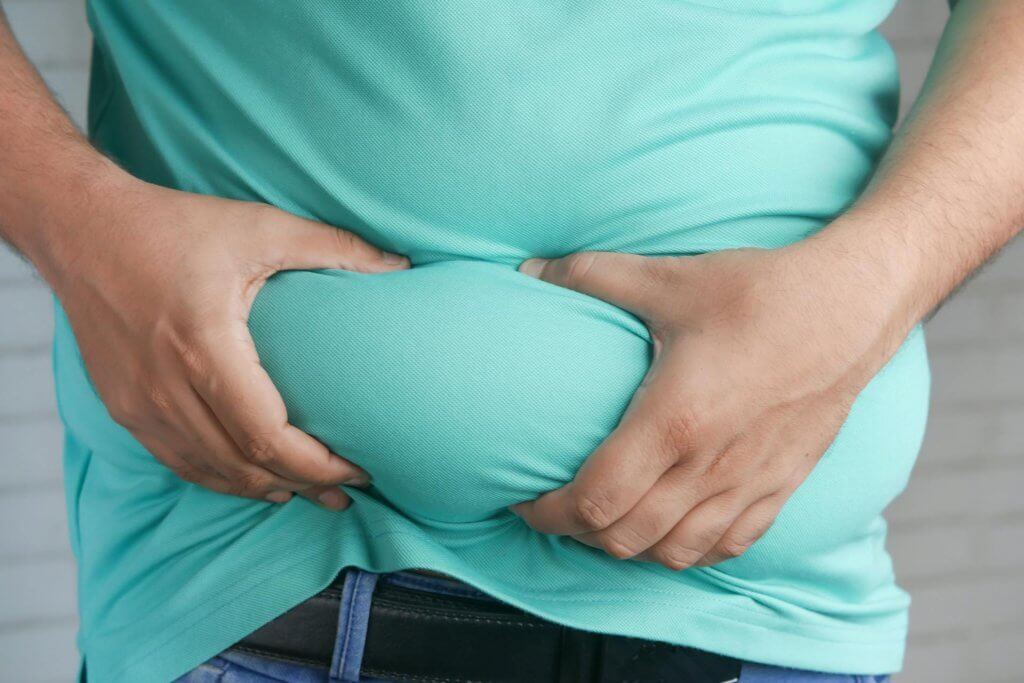
Skinfold measurements are easy and inexpensive to conduct and allow for a sufficiently accurate determination of fat and fat-free mass in everyday use: They show good agreement both at individual points in time [4] and over time [8] [9] compared to reference measurement methods.
The disadvantage is that the reliability of the measurement depends on the person that does the measure and their skills in using the method, as well as the quality of the measuring equipment. Even if the determination of fat and fat-free mass can be quite accurate, the skinfold measurement in isolation is primarily suitable for determining body fat content, but less so for muscle mass. As mentioned, this is because the fat-free mass includes not only muscle mass but also bone mass and body water, which the skinfold measurement cannot distinguish as an indirect method [7].
BIA Measurement
BIA stands for bioelectrical impedance analysis. Put simply, a BIA scale is a scale that not only measures your body weight, but also your body water (intracellular and extracellular depending on the technology) according to an extended 3C or 4C model and deducts from this the FM and FFM separately [10] [11]- Jackpot.
During BIA measurements, imperceptible electrical currents flow through the body. With the most common BIA scales for home use, you simply stand on the scale with bare feet and the device sends the current through your body. By combining the resistances that the different body compartments generally have, different current frequencies used by the device, different water concentration indicators of the types of cell tissue, as well as height, weight and gender, a BIA scale can use an algorithm to determine the extracellular and intracellular body water and indirectly derive the FM and FFM [10].
BIA (scale) measurements generally offer the potential to quantify body composition relatively precisely, separated by compartments [12]. In particular, because the amount of body water can be determined in isolation and the fat and fat-free mass can be derived from this, BIA measurements are in principle very useful for assessing physique development: Changes in body weight can in principle be specifically attributed to changes in cell mass (fat or muscle) or (!) body water and therefore do not lead to false conclusions.
Both for measurements at individual points in time [4] and for long-term measurements of body composition during physique development programs [8], BIA measurement results show good agreement with reference methods. Even though there were slight overestimations and underestimations of fat-free mass in various studies, the deviations are rather small overall [13]. However, the probably biggest advantages are the ease of use and the low cost. BIA scales can be bought for under €30 and individual measurements are completed within a few seconds.
Nevertheless, there are a few things to consider when it comes to BIA measurements and their results. First, the accuracy of the values for the individual compartments depends heavily on the respective manufacturer and the technologies and algorithms used [14]. Second, BIA measuring devices with additional contact points for the hand or other body parts, as used in professional settings, are more accurate than BIA scales with contact points only for the feet [15]. Third: Personal characteristics such as gender and the current state of body composition must be taken into account when measuring, as they can influence the derived values [16]. Fourth: Both the hydration status – i.e. how much you drank before a measurement – and when and how much you ate before a measurement can influence the results [15]. Fifth: Even if a BIA scale can display the FM and FFM “free” of body water, it does not separate the cell mass of the FFM into muscle and organ tissue.
Despite these disadvantages, BIA measurements are useful for assessing physique development, at least as a directional indicator. First: Most BIA scales are now smartphone compatible and personal data such as gender, height and activity status are integrated into the calculations. Second: If the measurement conditions are the same over time (ideally immediately after getting up in the morning and a quick trip to the toilet), the associated sources of error are also minimized, or at least held constant. Third (or fifth point above): Even if the values for FM and especially muscle mass are not absolutely accurate (determinable), the compartments that are “not of interest” for physique development (bone and organ mass) are very stable [17], so that changes in the measured values - especially because body water is determined separately – allow good statements to be made about fat loss and muscle building. In addition, a number of tests have now been carried out that show that common BIA scales for home use can sometimes produce very accurate measurements (see the next post). Given how cheap and easy the measurements can be carried out at home, a BIA scale is definitely worth having in your body composition tracking system.
Other Measurement Methods – Hydrodensitometry, ADP, DXA, CT & MRI
In order not to make this post any longer: There are a number of other measurement methods for determining body composition. They should be mentioned here because some of them can measure at the 4C model level or higher and, above all, specifically at body part level. The methods are: hydrodensitometry, air displacement plethysmography (ADP, measured with Bod Pod), dual X-ray absorptiometry (DXA), computer tomography (CT) and magnetic resonance imaging (MRI). Since these cannot be used at home, they are not very interesting for us here. However, these measurements can done at various providers, but they cost comparatively a lot.
Take-Aways
There are various measurement methods for determining body composition, which differ depending on whether and how many compartments they can determine separately, how accurate the measurements are, whether they are indirect for the whole body or specific to body parts, and how easy the measurement can be carried out.
Summary of the Advantages and Disadvantages of the Individual Measurement Methods
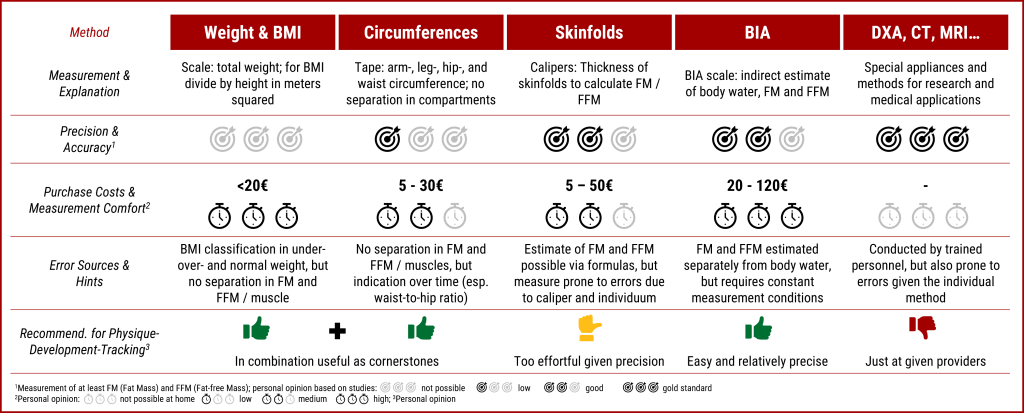
Fundamentally, several methods should be combined to measure body composition – especially for the accurate determinations or indications of changes in stored fat and muscle mass. If you include several values, you have a fairly reliable tracking tool as a basis for evaluating physique development.
Outlook
In the second part on body composition measurements, we will introduce you to a specific tracking system for body composition. This will allow you to evaluate the success of both a diet and a muscle building program and make any necessary adjustments.
References
[1] B. Schoenfeld, Science and Development of Muscle Hypertrophy, 2nd ed. Human Kinetics, 2020. doi: 10.5040/9781492595847.
[2] L. B. Baker, J. A. Lang, and W. Larry Kenney, “Change in body mass accurately and reliably predicts change in body water after endurance exercise,” Eur. J. Appl. Physiol., vol. 105, no. 6, pp. 959–967, Apr. 2009, doi: 10.1007/s00421-009-0982-0.
[3] T. Abe, S. J. Dankel, and J. P. Loenneke, “Body Fat Loss Automatically Reduces Lean Mass by Changing the Fat‐Free Component of Adipose Tissue,” Obesity, vol. 27, no. 3, pp. 357–358, Mar. 2019, doi: 10.1002/oby.22393.
[4] W. D. Van Marken Lichtenbelt, F. Hartgens, N. B. J. Vollaard, S. Ebbing, and H. Kuipers, “Body Composition Changes in Bodybuilders: A Method Comparison,” Med. Sci. Sports Exerc., vol. 36, no. 3, pp. 490–497, Mar. 2004, doi: 10.1249/01.MSS.0000117159.70295.73.
[5] R. C. Weisell, “Body mass index as an indicator of obesity,” Asia Pac. J. Clin. Nutr., vol. 11, no. s8, Dec. 2002, doi: 10.1046/j.1440-6047.11.s8.5.x.
[6] E. L. Thomas, J. A. Fitzpatrick, S. J. Malik, S. D. Taylor-Robinson, and J. D. Bell, “Whole body fat: Content and distribution,” Prog. Nucl. Magn. Reson. Spectrosc., vol. 73, pp. 56–80, Aug. 2013, doi: 10.1016/j.pnmrs.2013.04.001.
[7] D. Brodie, V. Moscrip, and R. Hutcheon, “Body Composition Measurement: A Review of Hydrodensitometry, Anthropometry, and Impedance Methods,” Nutrition, vol. 14, no. 3, pp. 296–310, Mar. 1998, doi: 10.1016/S0899-9007(97)00474-7.
[8] L. P. Kilduff, S. Lewis, M. I. C. Kingsley, N. J. Owen, and R. E. Dietzig, “Reliability and Detecting Change Following Short-Term Creatine Supplementation: Comparison of Two-Component Body Composition Methods,” J. Strength Cond. Res., vol. 21, no. 2, p. 378, 2007, doi: 10.1519/R-19245.1.
[9] A. M. Silva, D. A. Fields, A. L. Quitério, and L. B. Sardinha, “Are Skinfold-Based Models Accurate and Suitable for Assessing Changes in Body Composition in Highly Trained Athletes?,” J. Strength Cond. Res., vol. 23, no. 6, pp. 1688–1696, Sep. 2009, doi: 10.1519/JSC.0b013e3181b3f0e4.
[10] U. G. Kyle et al., “Bioelectrical impedance analysis—part I: review of principles and methods,” Clin. Nutr., vol. 23, no. 5, pp. 1226–1243, Oct. 2004, doi: 10.1016/j.clnu.2004.06.004.
[11] L. C. Ward, “Human body composition: yesterday, today, and tomorrow,” Eur. J. Clin. Nutr., vol. 72, no. 9, pp. 1201–1207, Sep. 2018, doi: 10.1038/s41430-018-0210-2.
[12] L. C. Ward, “Bioelectrical impedance analysis for body composition assessment: reflections on accuracy, clinical utility, and standardisation,” Eur. J. Clin. Nutr., vol. 73, no. 2, Art. no. 2, Feb. 2019, doi: 10.1038/s41430-018-0335-3.
[13] Antonio et al., “Comparison of Dual-Energy X-Ray Absorptiometry (DXA) versus a Multi-frequency Bioelectrical Impedance (InBody 770) Device for Body Composition Assessment after a 4-Week Hypoenergetic Diet,” J. Funct. Morphol. Kinesiol., vol. 4, no. 2, p. 23, Apr. 2019, doi: 10.3390/jfmk4020023.
[14] M. I. Frisard, F. L. Greenway, and J. P. DeLany, “Comparison of Methods to Assess Body Composition Changes during a Period of Weight Loss,” Obes. Res., vol. 13, no. 5, pp. 845–854, May 2005, doi: 10.1038/oby.2005.97.
[15] G. M. Tinsley, E. Morales, J. S. Forsse, and P. W. Grandjean, “Impact of Acute Dietary Manipulations on DXA and BIA Body Composition Estimates,” Med. Sci. Sports Exerc., vol. 49, no. 4, pp. 823–832, Apr. 2017, doi: 10.1249/MSS.0000000000001148.
[16] E. A. Cumberledge, C. Myers, J. J. Venditti, and J. L. Andreacci, “The Effect of the Menstrual Cycle on Body Composition Determined by Contact-Electrode Bioelectrical Impedance Analyzers,” 2018.
[17] T. B. Chaston, J. B. Dixon, and P. E. O’Brien, “Changes in fat-free mass during significant weight loss: a systematic review,” Int. J. Obes., vol. 31, no. 5, pp. 743–750, May 2007, doi: 10.1038/sj.ijo.0803483.